Jichang Garden: A Ming Garden That Borrows a Mountain
Jichang Garden lies at the eastern foot of Huishan in the western part of Wuxi, inside the old temple quarter now sold as Huishan Ancient Town. It is also called the Qin Garden, after the family that owned it for some four hundred years. The name comes from a line by Wang Xizhi about lodging one's ease among hills and water. The garden is small, 14.85 mu or about one hectare, and long and narrow from north to south. Its fame rests on one trick. Huishan rises right behind it and the pagoda on Xishan stands in the distance, and the garden was laid out so that both read as part of it. It was listed as a nationally protected site in 1988.
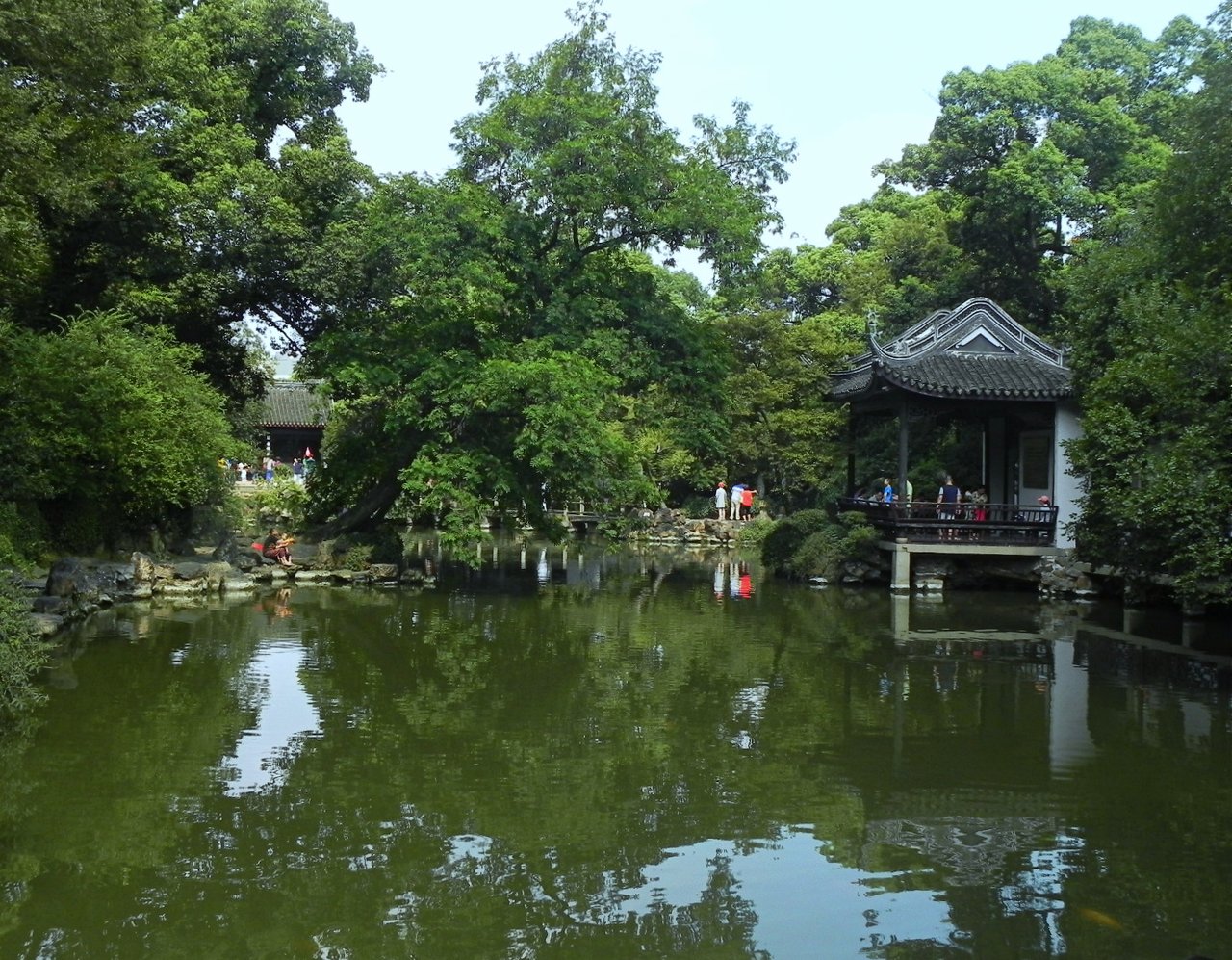
Four centuries in one family
In the Yuan the site held two monks' lodges belonging to Huishan Temple. In the Zhengde years of the Ming, between 1506 and 1521, Qin Jin, a former minister of war at Nanjing and a descendant of the Song poet Qin Guan, bought one of them and turned it into a villa. After his death it passed to relatives and then to Qin Yao, a governor of Huguang. In 1591 Qin Yao lost his post when his patron Zhang Juzheng fell from favour, came home to Wuxi, and renamed the garden Jichang to console himself. English Wikipedia says he wrote a poem for each of its twenty named scenes.
The garden took its present shape in the early Qing. Qin Yao's great-grandson Qin Dezao brought in the garden designer Zhang Lian and his nephew Zhang Shi, who reworked the hills, rocks and water. The Kangxi and Qianlong emperors each made six southern tours and stopped here every time. Kangxi wrote an inscription for the garden. On his first tour in 1751 Qianlong took a painting of it back to Beijing and had a copy built on Longevity Hill, the Garden of Harmonious Interest that still stands in the Summer Palace. He also called the Qin garden the oldest of the famous sites of Jiangnan.
The family nearly lost it more than once. Early in the Yongzheng reign a Qin grandson was caught up in a court struggle and the garden was confiscated. Its southwest corner was cut off for a county shrine to chaste widows. It came back to the family after another Qin placed third in the palace examination in 1736 and petitioned for his father's release. In 1746 the family turned one hall into an ancestral shrine so that the garden would belong to the lineage as a whole. Most buildings burned in the wars of the 1850s and 1860s. In 1952 the Qin descendants gave the garden to the state, and the old widows' shrine was folded back in as Bingli Hall.
Walking the garden
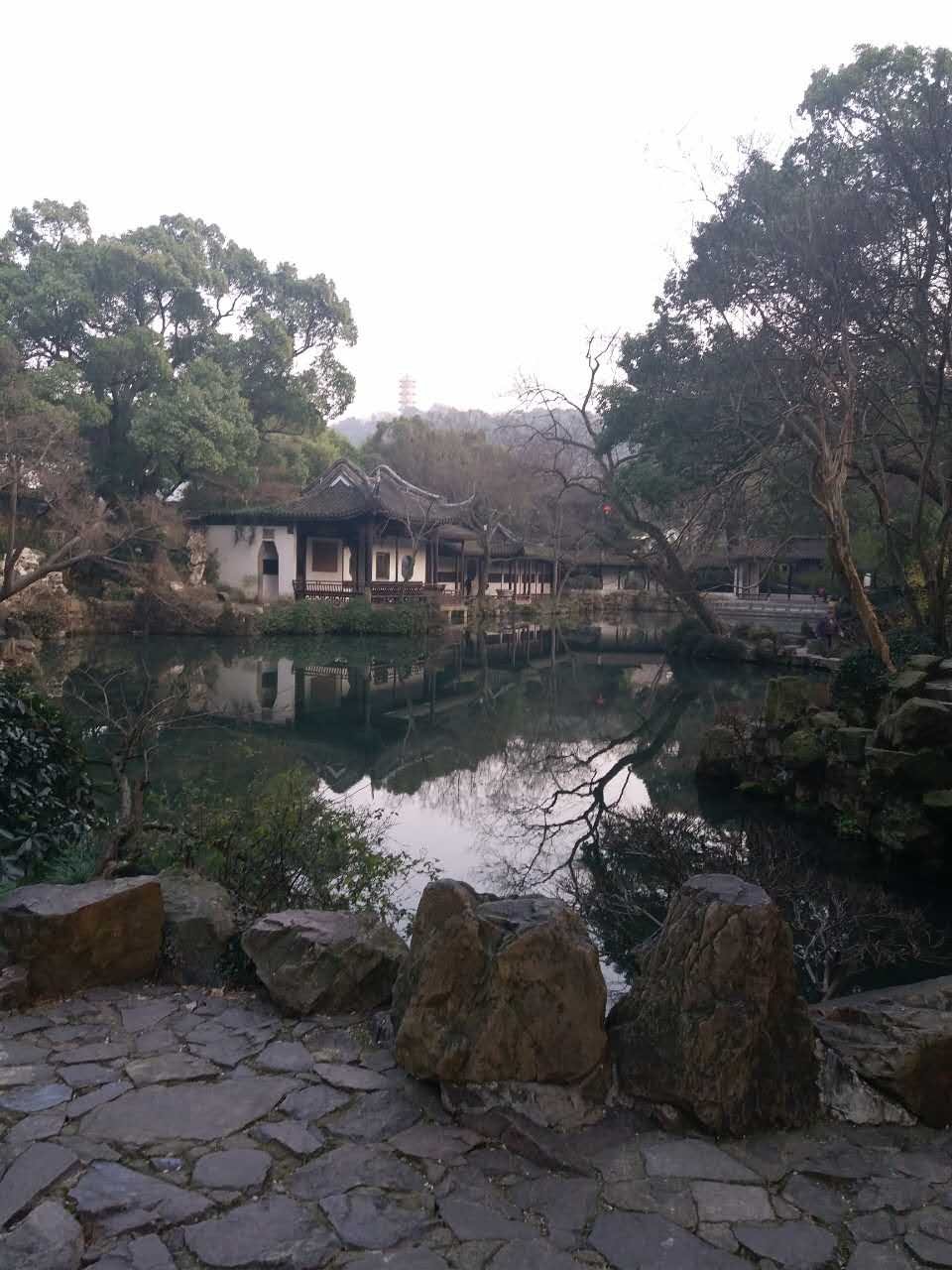
Coming in from the temple side, the first building is Fenggu Xingwo, the name Qin Jin gave his villa, hung with couplets by the late Qing statesman Weng Tonghe. The heart of the garden is a long pool called Jinhuiyi, the Ripples of Gathered Brocade. A sandy spit with two large trees, the Crane Step Beach, pushes out from the west bank, and a fish-viewing pavilion juts from the east bank toward it, so the water seems to narrow and open again. The hexagonal Yupan Pavilion carries a story Chinese Wikipedia repeats. Qianlong played chess there with a monk of Huishan Temple and was badly beaten. The monk then let him win, and the emperor, who knew he had been humoured, named the pavilion for his bad mood.
The west side is all hill, earth in the middle and stone at the ends, planted so that it seems to run straight into Huishan. Water from the Second Spring Under Heaven is led in through a stone gully, the Bayinjian or Eight-Tone Gully, where it drops and turns between rocks. The sound is the point here. Stand inside the gully for a minute and the noise of the tour groups falls away.
Borrowed views
From the pool's east side look west and north. Huishan fills the background, and on a clear day the Longguang Pagoda on Xishan shows above the trees. Chinese garden writers call this jiejing, borrowing a view. Many of the city gardens in Suzhou are closed in by high walls, while Jichang opens out to the mountain. Chinese Wikipedia sums it up with the phrase "a mountain in the garden, a garden in the mountain".
Tickets and hours
Jichang Garden is in the paid heritage zone of Huishan Ancient Town. Wuxi Bendibao lists a combined ticket for the heritage zone and the Xihui scenic park at 70 yuan, and online sellers show it from about 65 yuan. Recent listings give hours of roughly 08:00 to 17:00 on weekdays and to 17:30 at weekends, with last entry half an hour before closing, plus a separate evening session in summer. Check the day's notice, as capacity is limited and some concessions now have daily quotas.
Getting there
The garden's gate faces the ancient town streets, close to Huishan Temple and the Second Spring. Wuxi Metro has a station called Huishan Ancient Town, a short walk away, and Wuxi railway station is about fifteen minutes by taxi. The ancient town streets are free, so you can eat and wander before or after the garden.
How long and when
An hour covers the garden at a slow pace. Add another hour or two for Huishan Temple, the Second Spring and the shrine streets. Go at opening or late in the afternoon, when the tour groups thin out. The pool and the gully are small, and they feel very different with twenty people in them or two hundred.
Things to confirm before you go
- Which ticket includes the garden, as the town sells several combinations.
- Opening and last entry times for your day.
- Whether a summer evening session is running.
- Concessions and quotas if you are travelling with older relatives.
Frequently asked questions
Why is Jichang Garden famous?
Qianlong called it the oldest of the famous sites of Jiangnan and copied it in the Summer Palace. It also stayed with one family for about four centuries.
How big is Jichang Garden?
About 14.85 mu, roughly one hectare, laid out on a long north to south strip.
Is it the same ticket as Huishan Ancient Town?
The town streets are free. The garden is in the paid heritage zone, usually sold as a combined ticket with the Second Spring and Huishan Temple.
Jichang or a Suzhou garden?
Jichang is smaller and more open to its landscape. If you have seen the Suzhou gardens, it adds a different idea.
Sources
Facts in this article were checked against the following sources, retrieved 8 October 2026.
- 寄畅园, Chinese Wikipedia
- Jichang Garden, English Wikipedia
- 无锡寄畅园门票多少钱, Wuxi Bendibao
- 惠山古镇·寄畅园开放时间, Qunar
Photos are from Wikimedia Commons under the licences shown in each caption.