Lingshan Grand Buddha: A Bronze Giant on Taihu
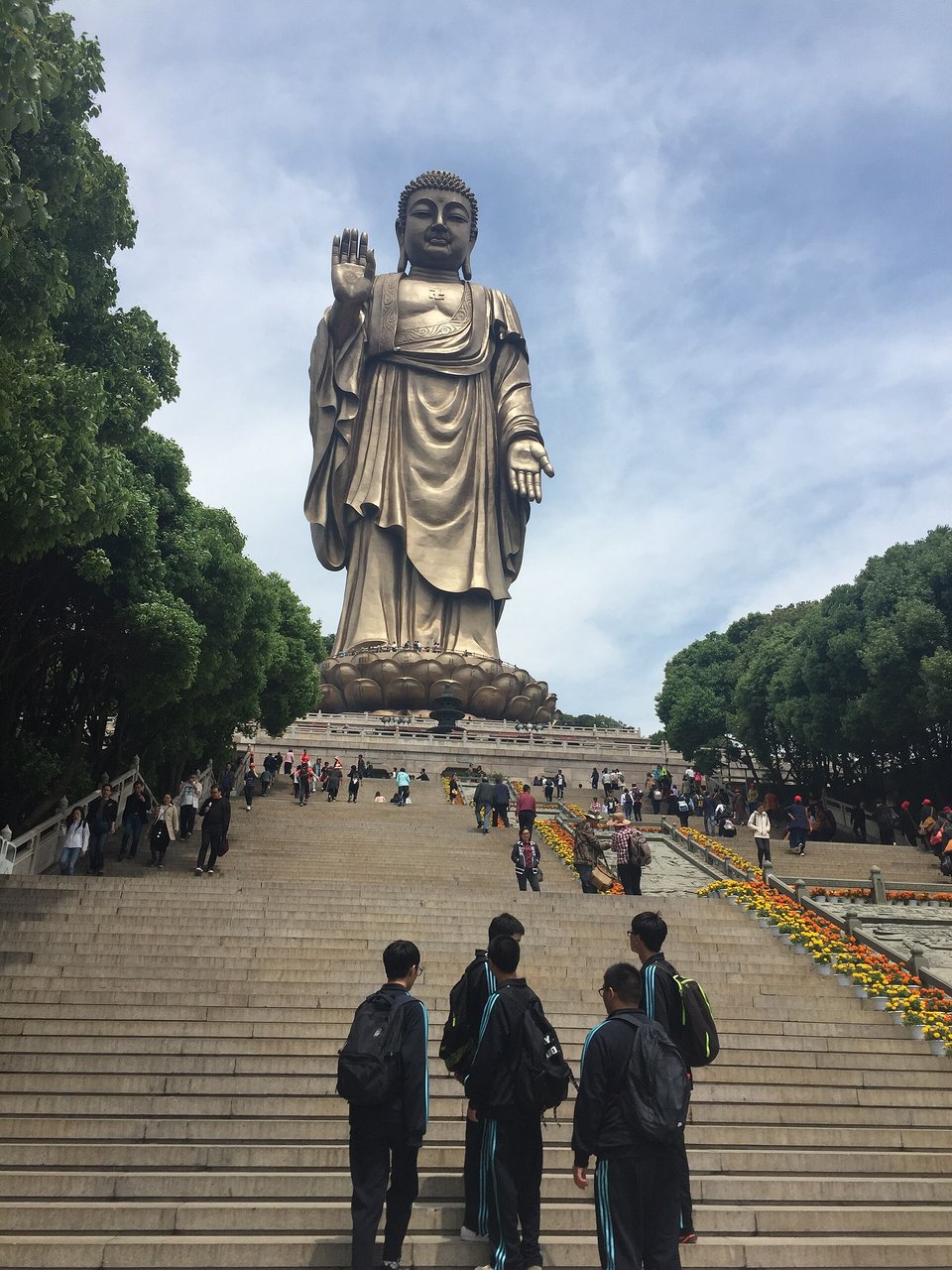
The Lingshan Grand Buddha stands on the Mashan peninsula in Binhu District, on the north shore of Taihu, a long ride southwest of central Wuxi. The figure is 88 metres of bronze and used more than 700 tonnes of metal. It was designed and cast under Wu Xianlin of Nanjing's Chenguang group. Ground was broken on 20 April 1994, the head went on in April 1997, and the statue was consecrated on 15 November 1997. Around it has grown the Lingshan Scenic Area, a national 5A site since 2009, with a fountain show, a vast domed hall and a Tibetan-style mandala. This is a modern religious landmark from the 1990s and 2000s. Old Wuxi is back in town at Huishan Ancient Town and along the Qingming Bridge canal.
How the Buddha came to be here
The hill behind the statue is called Little Lingshan. The Wuxi archives office repeats the local tradition that the Tang monk Xuanzang gave it that name, after the Lingshan, or Vulture Peak, of the sutras. Xiangfu Temple, directly in front of the Buddha, is the one old institution in the scenic area. The Jiangsu provincial tourism office says it was founded in the Tang and renamed in the Xiangfu era of the Northern Song. The present buildings are post-1949 rebuilds.
Chinese Wikipedia is direct about how the project was paid for. From the start it was a partnership between the temple and a company, and it was not funded by donations from the faithful. The Jiangsu tourism office describes the statue as the first phase of a planned scenic area. Zhao Puchu, then head of the Buddhist Association of China, said it completed a set of "five Buddhas for five directions". In that scheme Lingshan is the east, the Tian Tan Buddha in Hong Kong the south, the Leshan Giant Buddha the west, Yungang the north and Longmen the centre.
The statue itself
Chinese sources call the figure Shakyamuni. English Wikipedia labels it an Amitabha and says the 88 metres include a 9-metre lotus pedestal. The provincial tourism office gives 101.5 metres if the base is counted. The face follows the sutra list of the Buddha's bodily marks, the two hands make two mudras, and a swastika, the old Buddhist sign of merit, sits on the chest.
The approach is a long axis from the car parks and gates, past a stone screen wall that the archives office measures at 39.8 metres long and 7 metres high, then through Xiangfu Temple to the stairway. From the Buddhist culture museum at the statue's base a lift goes up to a terrace at the feet, where visitors touch the Buddha's foot for luck, a play on the Chinese phrase for "hugging the Buddha's feet". On a clear day the terrace looks south over Taihu.
Nine Dragons Bathing the Buddha
Halfway along the axis is the second phase, a musical fountain sculpture called Nine Dragons Bathing the Buddha. It shows the birth of the Buddha as told in the sutras. When the music starts, a giant bronze lotus opens and a 7.2-metre gilded figure of the infant Buddha rises and turns while the nine dragons spray water over it. Between performances it is just a closed bronze flower on the plaza. Show times change by season. One October 2026 travel listing gave 10:00, 11:30, 14:45 and 16:45 on weekdays with an extra 13:00 show at weekends. Check the board at the gate, since the whole day's route tends to be planned around these slots.
The Brahma Palace and the mandala
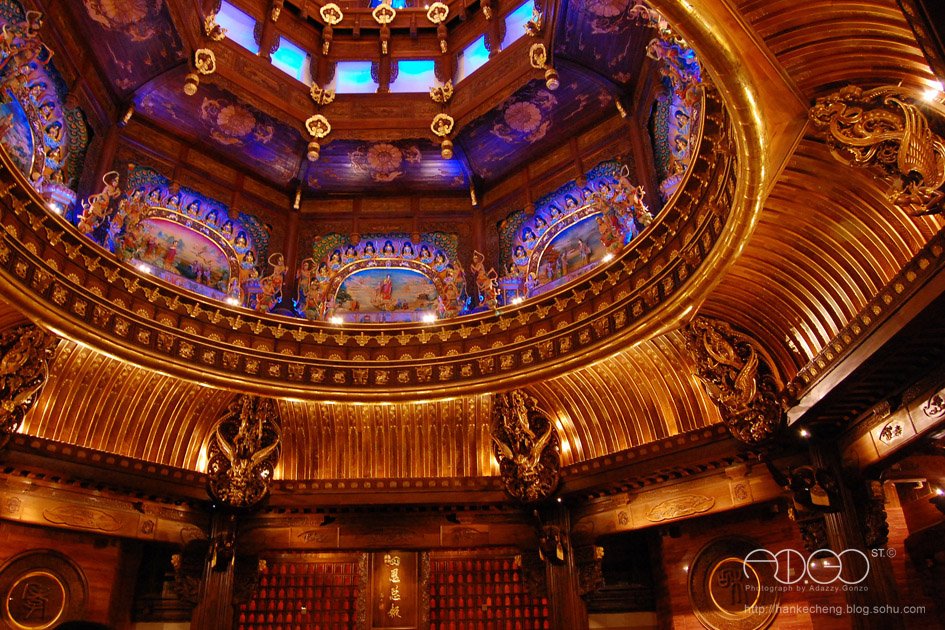
The Brahma Palace was the third phase and opened on 1 January 2009. The archives office gives it more than 70,000 square metres of floor, 150 metres wide and 180 metres deep, stepping up the hillside through an entrance hall, a long gallery, a domed tower hall and a theatre. The interior is a showcase of Chinese crafts. It has Dongyang woodcarving, murals in the Dunhuang manner, Yangzhou lacquer, cloisonné, Shoushan stone carving and Jingdezhen porcelain. In March 2009 the hall hosted the opening of the second World Buddhist Forum, and in 2012 the Buddhist Association of China named Lingshan the forum's permanent home. The resident stage show was being rebuilt in 2026, and the Yangtse Evening Post reported a cut in the ticket price while that work goes on.
East of the palace, the Five Mudra Mandala opened on 1 October 2011. It is a red-and-white Tibetan-style complex surrounded by water, with prayer wheels in the outer gallery and halls of thangka painting and statuary inside. A group of white pagodas in the Theravada style stands next to it. Taken together the three phases try to tell the Buddha's life and the spread of the religion in one walk, and they take most of a day.
Tickets and hours
In February 2026 the Yangtse Evening Post reported that the walk-up adult ticket had dropped to 160 yuan from 210, with concession tickets at 80 yuan and an online price of 150 yuan when booked the day before. Concessions cover children aged 6 to 18 and full-time students, and the scenic area runs frequent promotions. A 2026 listing gives opening hours of 07:00 to 17:00 from January to April and 07:00 to 17:30 from May to October, with the Brahma Palace open 09:00 to 18:00 in summer. Check the day's notice, as halls and shows keep their own hours.
Getting there
Lingshan is at 1 Lingshan Road, Mashan, well outside the city centre. A taxi from central Wuxi is the simplest way. Public transport works with a metro and bus combination, but leave time for it. Tour buses from Wuxi and from Shanghai also run here. Yuantouzhu is on the same side of the city, but the two make a long day together.
How long and when
Allow a half day at the least and a full day if you want the palace interiors, the mandala and a fountain show. Weekday mornings are quieter. A clear day matters more than the hour, since the reward at the top is the view over the lake.
Things to confirm before you go
- The current price, since 2026 brought a cut and frequent promotions.
- The Nine Dragons show times for your day.
- Which Brahma Palace halls and performances are open.
- Your return transport from Mashan before the gates close.
Frequently asked questions
Is the Lingshan Buddha old?
No. It was cast and consecrated between 1994 and 1997. Only Xiangfu Temple has older roots, and its buildings are modern too.
How tall is the Lingshan Grand Buddha?
The figure is 88 metres. With its base the provincial tourism office gives 101.5 metres.
How much is the ticket in 2026?
About 160 yuan at the gate and 150 yuan online a day ahead, by February 2026 press reports, with an 80-yuan concession.
Can I combine Lingshan with Yuantouzhu?
Yes, both are on the Taihu side, but each needs a half day. With only one day in Wuxi, pick one.
Sources
Facts in this article were checked against the following sources, retrieved 8 October 2026.
- 灵山大佛, Chinese Wikipedia
- Grand Buddha at Ling Shan, English Wikipedia
- 灵山胜境, Wuxi archives and local history office
- 水韵江苏佛文化主题景区 灵山胜境, Jiangsu Department of Culture and Tourism
- 灵山门票调整, Yangtse Evening Post via Tencent News, February 2026
- 灵山胜境开放时间, Qunar
Photos are from Wikimedia Commons under the licences shown in each caption.