Suzhou Travel Guide: Gardens, Canals and a Water Town in Three Days
Suzhou is the place to see the classical Chinese garden at its best, and it is half an hour from Shanghai by high-speed train. Give it two days for the old city, or three with a day trip to a water town such as Zhouzhuang. Start with the Humble Administrator's Garden at opening, 07:30. It is the most famous and most crowded of the gardens, and it needs a real-name booking 1 to 7 days ahead (80 yuan from April to October, except June). Walk Pingjiang Road afterwards. On day two, see Tiger Hill and its leaning pagoda, then the canal at Hanshan Temple. Leave the evenings for the canal streets or the skyline of Jinji Lake.
Planning a Suzhou stay
Book the big garden, then improvise. The Humble Administrator's Garden sells timed real-name tickets and sells out on holidays. Most other sights can be bought on the day. Suzhou Museum, next door to the garden, is free but also needs booking, and it is closed on Mondays.
One or two gardens is enough for most people. Suzhou has dozens, and nine of them are on the UNESCO list. After the Humble Administrator's Garden, choose one more with a different feel: the Lingering Garden for its corridors and rocks, the small Master of the Nets Garden, or the Lion Grove for its maze of rockery. Three in one day blur together.
Pick one water town. Zhouzhuang is the most famous and the busiest. Tongli is closer to the city and quieter. Don't try to do both.
When to come to Suzhou
Suzhou has four distinct seasons, with an annual mean of 17.2°C. The hottest month averages 29.1°C and the coldest 4.5°C. Spring (April and May) and autumn (October and November) are the best times: flowers in the gardens in spring, osmanthus scent and ginkgo leaves in autumn, and hairy crabs from Yangcheng Lake from about late September. The plum rains in June and July are hot, humid and wet, and the gardens' stone paths get slippery. Summer is also peak domestic travel season. Winter is cold and grey, but the gardens are much emptier, and bare branches over water have their own beauty.
Avoid the first week of May and the first week of October if you can. On those days the main gardens and Zhouzhuang are packed from opening.
How to get in and where to stay
By train. Suzhou has several stations, so check yours:
- Suzhou station is on the edge of the old city, on metro Lines 2 and 4. Trains from Shanghai take about 25 to 30 minutes.
- Suzhou North is on the Beijing–Shanghai high-speed line, north of the city, and is on metro Line 2.
- Suzhou Industrial Park station is east of the old city, closer to Jinji Lake.
- Suzhou South, on the newer Shanghai–Suzhou–Huzhou line, has fast trains to Hangzhou West in 45 minutes to an hour.
By air. Suzhou has no airport of its own. Most people fly into Shanghai Hongqiao and take the train, which is quick from the airport's own railway station. Wuxi Sunan airport is another option.
Where to stay. Stay inside the old city (Gusu district), around Pingjiang Road, Guanqian Street or Shiquan Street, to walk to the gardens and canals. The Jinji Lake area in the Industrial Park is modern and convenient for the lake at night, but you'll take the metro to every old sight.
Places worth visiting
The Humble Administrator's Garden
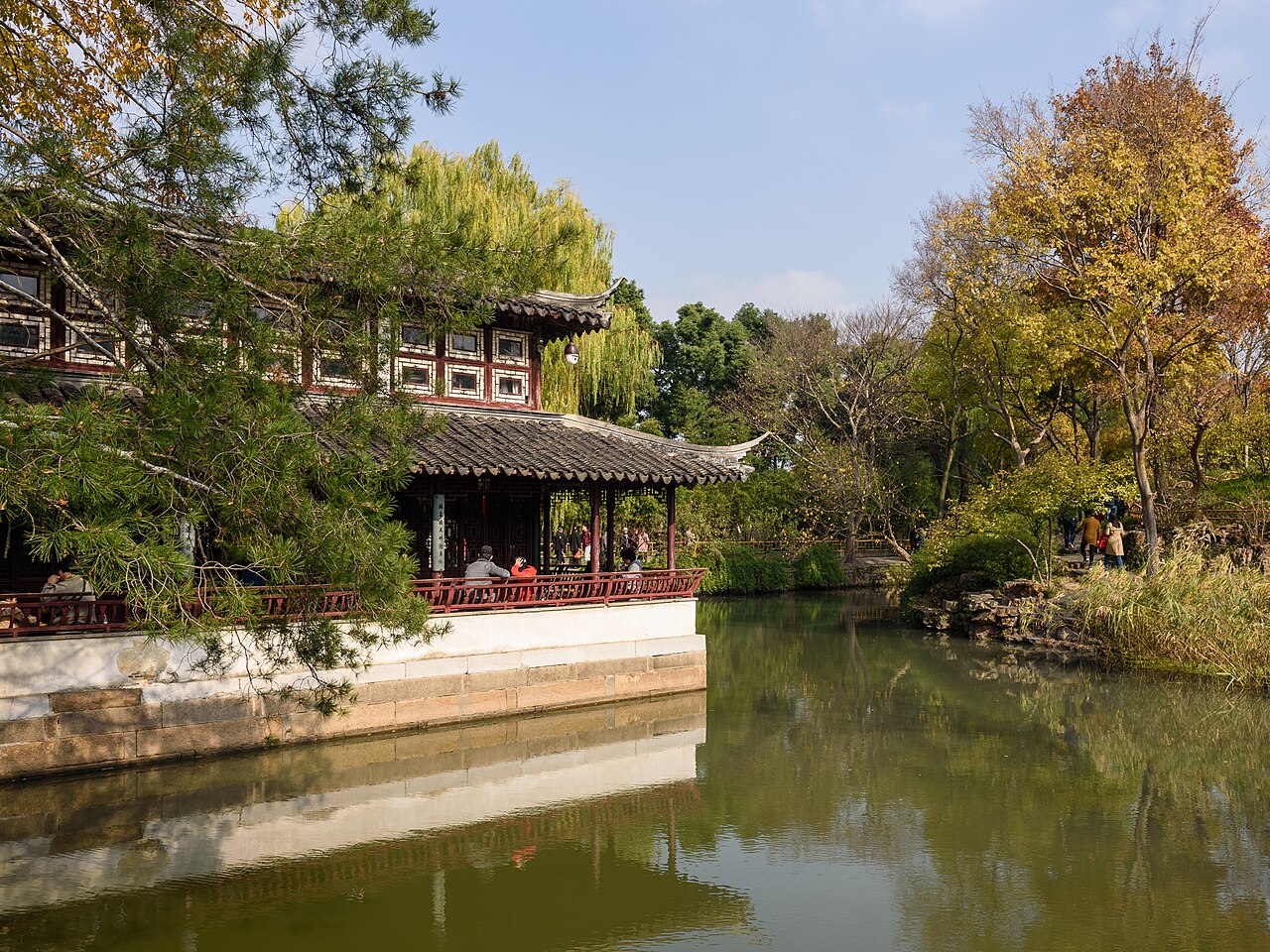
In 1509, the fourth year of the Zhengde reign, the censor Wang Xianchen retired to Suzhou and built a garden on the site of an old Buddhist temple. The name comes from a line by the Western Jin writer Pan Yue, about how growing and selling vegetables is a simple man's way of governing. Tradition says the painter Wen Zhengming drew up the design. Built around water, it covers about 46,000 square metres in three parts, with the central garden, home to the Hall of Distant Fragrance (Yuanxiang Tang), the finest. It is one of China's four great gardens, and has been on the UNESCO list with other Suzhou gardens since 1997.
In 2026 tickets cost 80 yuan in April, May and July to October, and 70 yuan from November to March and in June. Booking is real-name, for a time slot, 1 to 7 days ahead. From March to October it opens 07:30 to 17:30, with last entry at 17:00. Metro Line 6 stops at Zhuozhengyuan Subo station. Go at opening. By 10:00 the central garden is shoulder to shoulder. Route and booking details are on the Humble Administrator's Garden page.
Pingjiang Road
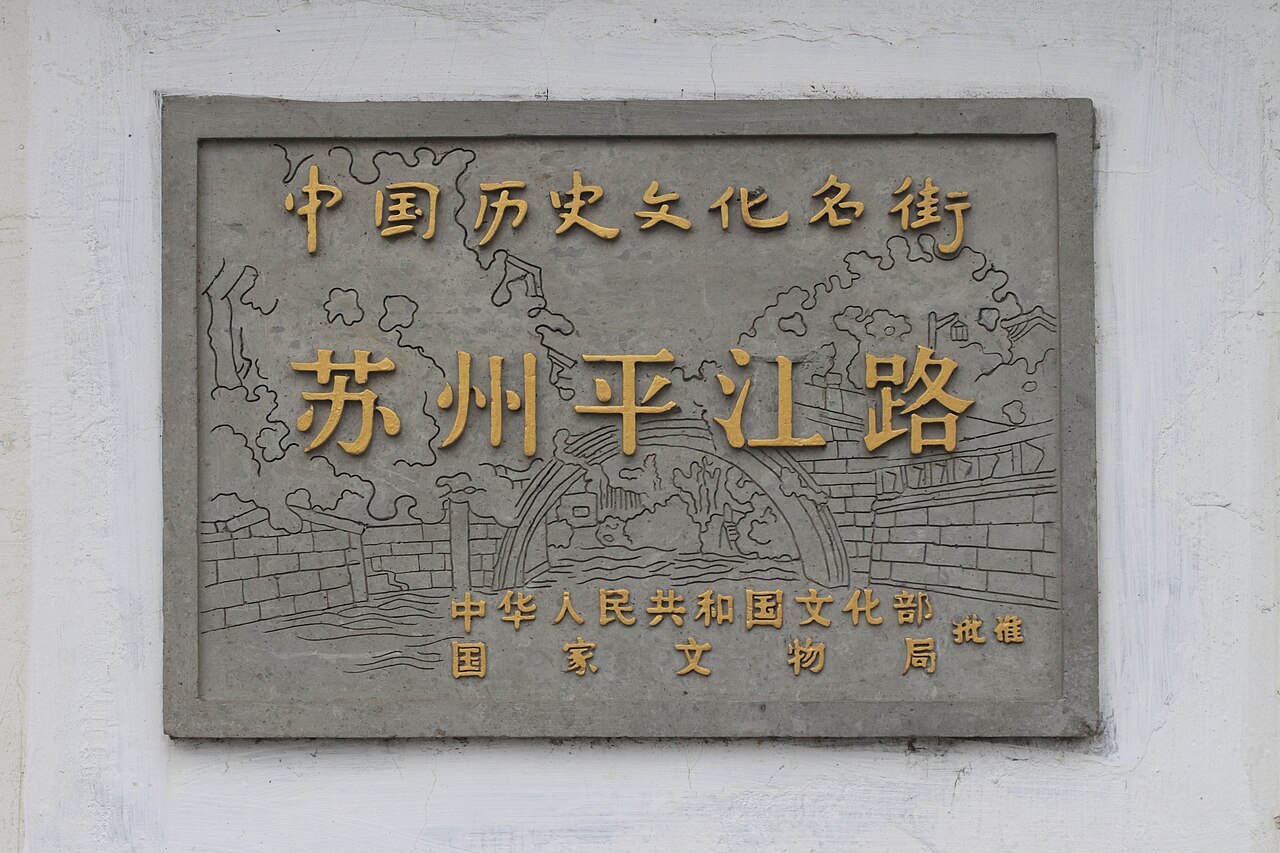
A 1.6 km street running north to south through the east of the old city, with a canal alongside and lanes branching off on both sides. Its layout has hardly changed in about 800 years. People still live here, among teahouses, bookshops and snack bars, and it is calmer than the rebuilt shopping streets. It is free to walk, and boats on the canal charge extra. The north end is a few minutes from the Humble Administrator's Garden. The south end is near Xiangmen station on Line 1. See Pingjiang Road.
Tiger Hill
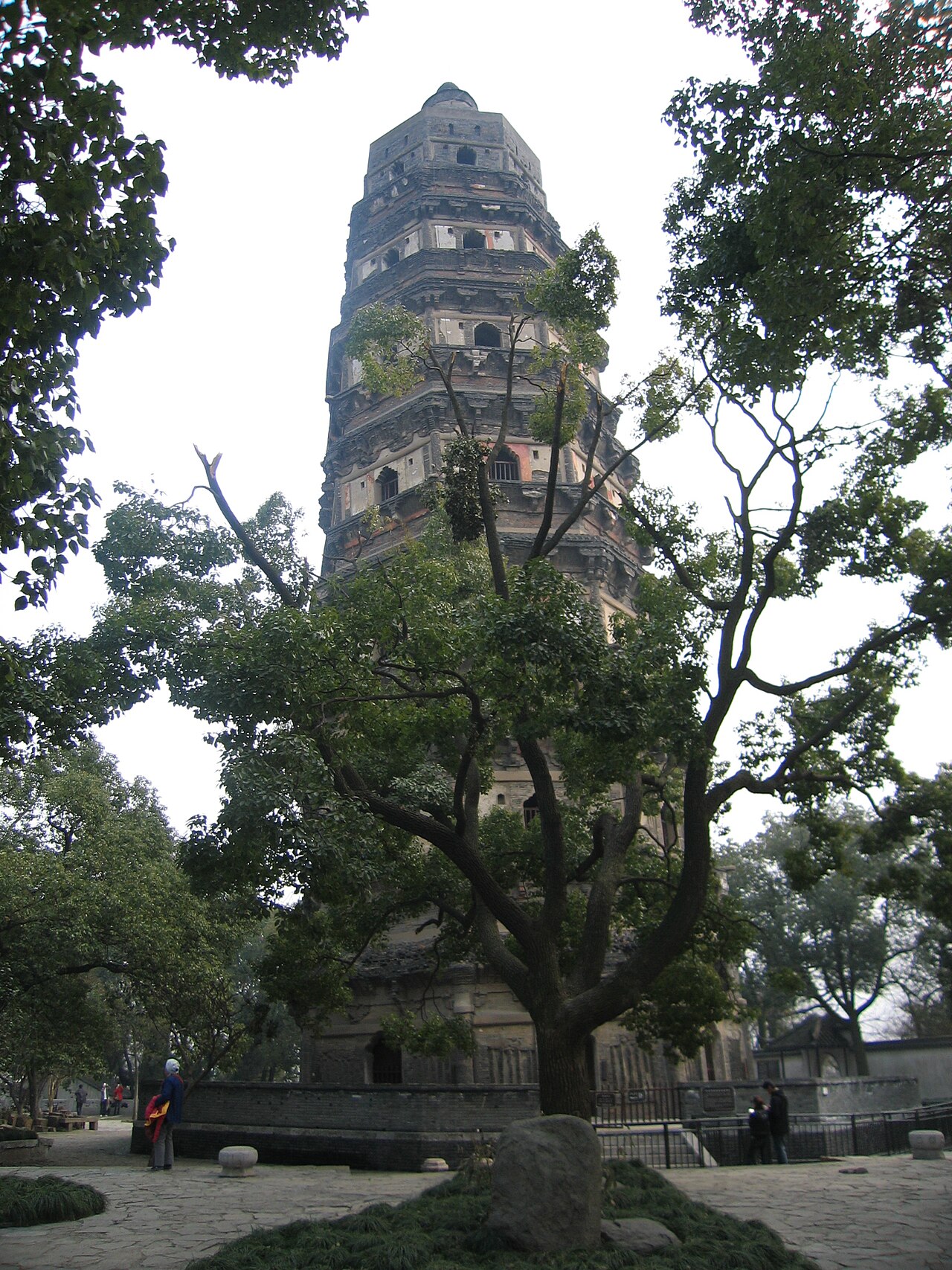
A small wooded hill north-west of the old city, long called the finest sight in Wu. Su Dongpo is quoted as saying that to visit Suzhou without seeing Tiger Hill would be a lifelong regret. The Yunyan Temple Pagoda on top, a seven-storey brick tower 47.7 metres high, was built between 959 and 961. During a Ming repair in 1638 it was found to be leaning north-east, so the top storey was rebuilt with its weight shifted south. It still leans and is called China's leaning tower. Below it are the Sword Pool, where King Helü of Wu is said to be buried with his swords, and the broad Thousand People Rock. In 2026 tickets cost 70 yuan in peak months and 60 yuan off-peak. Take Line 6 to Huqiu station. Allow half a day. See Tiger Hill.
Hanshan Temple and Maple Bridge
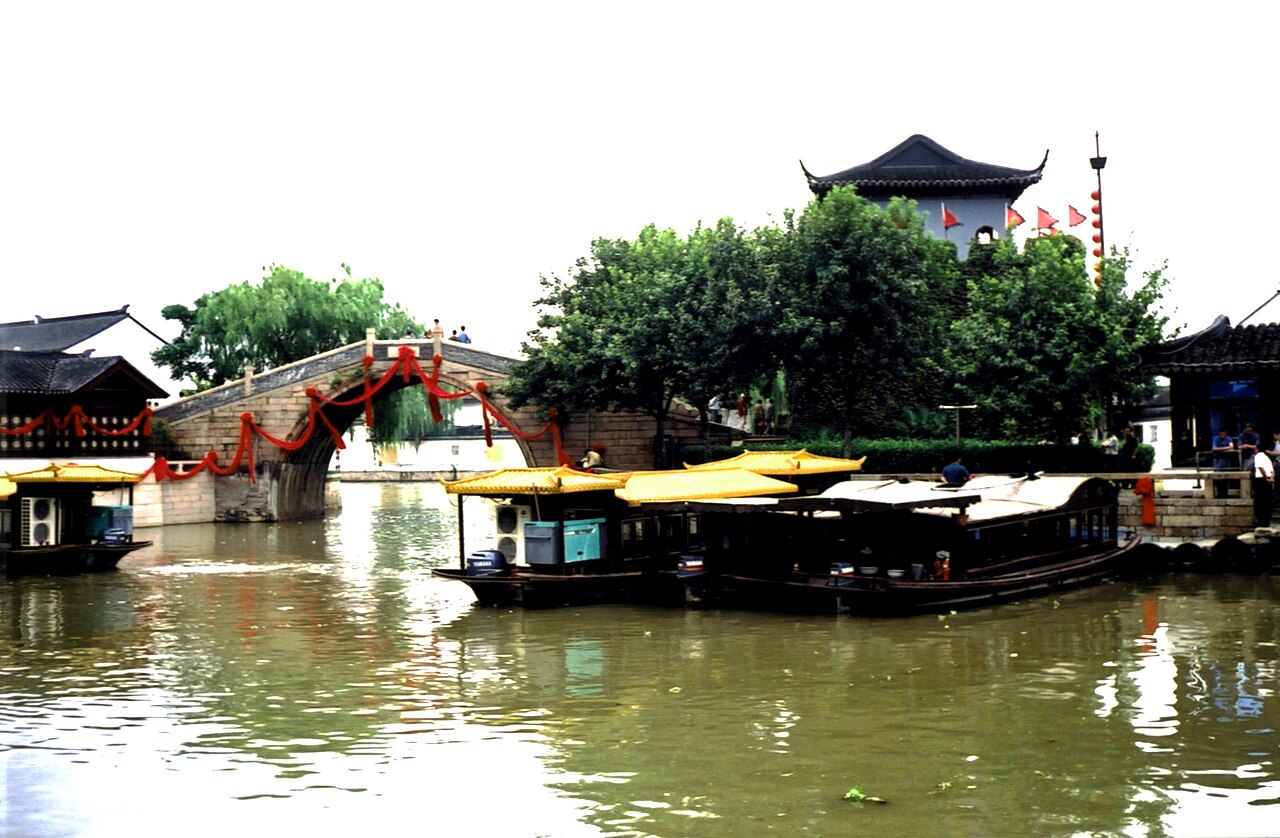
The temple was founded in the Tianjian reign of the Liang (502 to 519) and took its name from the Tang monk-poets Hanshan and Shide. The Tang poet Zhang Ji made it famous with "Night Mooring at Maple Bridge", whose lines about the midnight bell carrying to a traveller's boat every Chinese schoolchild learns. It is a compact temple. The yellow walls, the Puming Pagoda, the stele corridor with the poem carved in many hands, and the arched Maple Bridge over the canal outside take one to two hours. Tickets cost 20 yuan, and it opens 07:30 to 19:00 from April to December. Bus 9002 stops outside. The metro is 1.7 km away. See Hanshan Temple.
Zhouzhuang water town
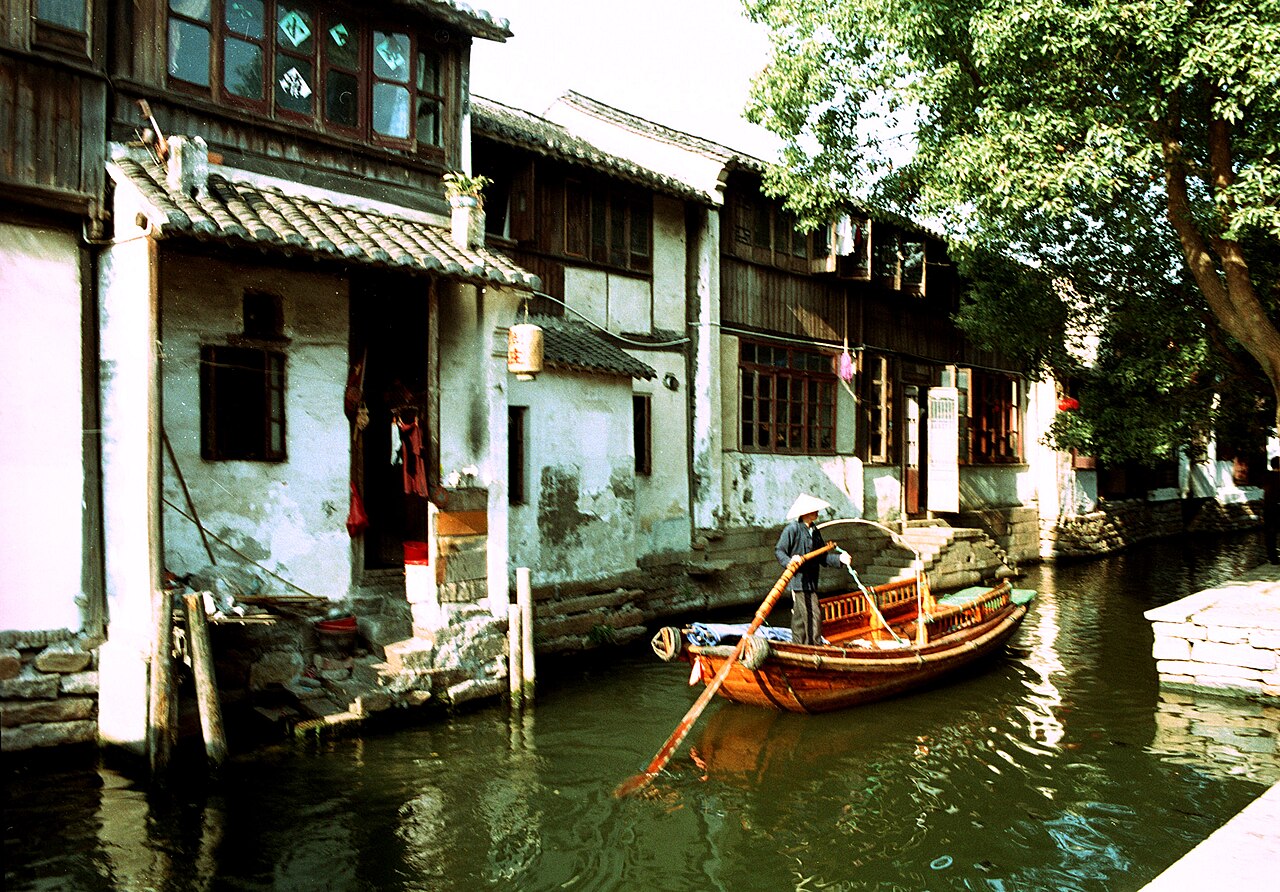
A canal town in Kunshan, ringed by lakes, with Ming and Qing houses built along the water. Its Twin Bridges, built in 1843, became famous after Chen Yifei's painting of them was presented to Deng Xiaoping in 1984, and Zhouzhuang's tourism grew from there. The Shen Hall belonged to the family of Shen Wansan, the legendary merchant said to have paid for part of Nanjing's city wall. Since 9 July 2026 the ticket is 80 yuan (down from 100), valid for three consecutive days after registration. Buses run from the bus station at Suzhou station's north square, or take a car, about an hour. Stay the night if you can: the lanes are calm early and late. See Zhouzhuang.
Jinji Lake at night
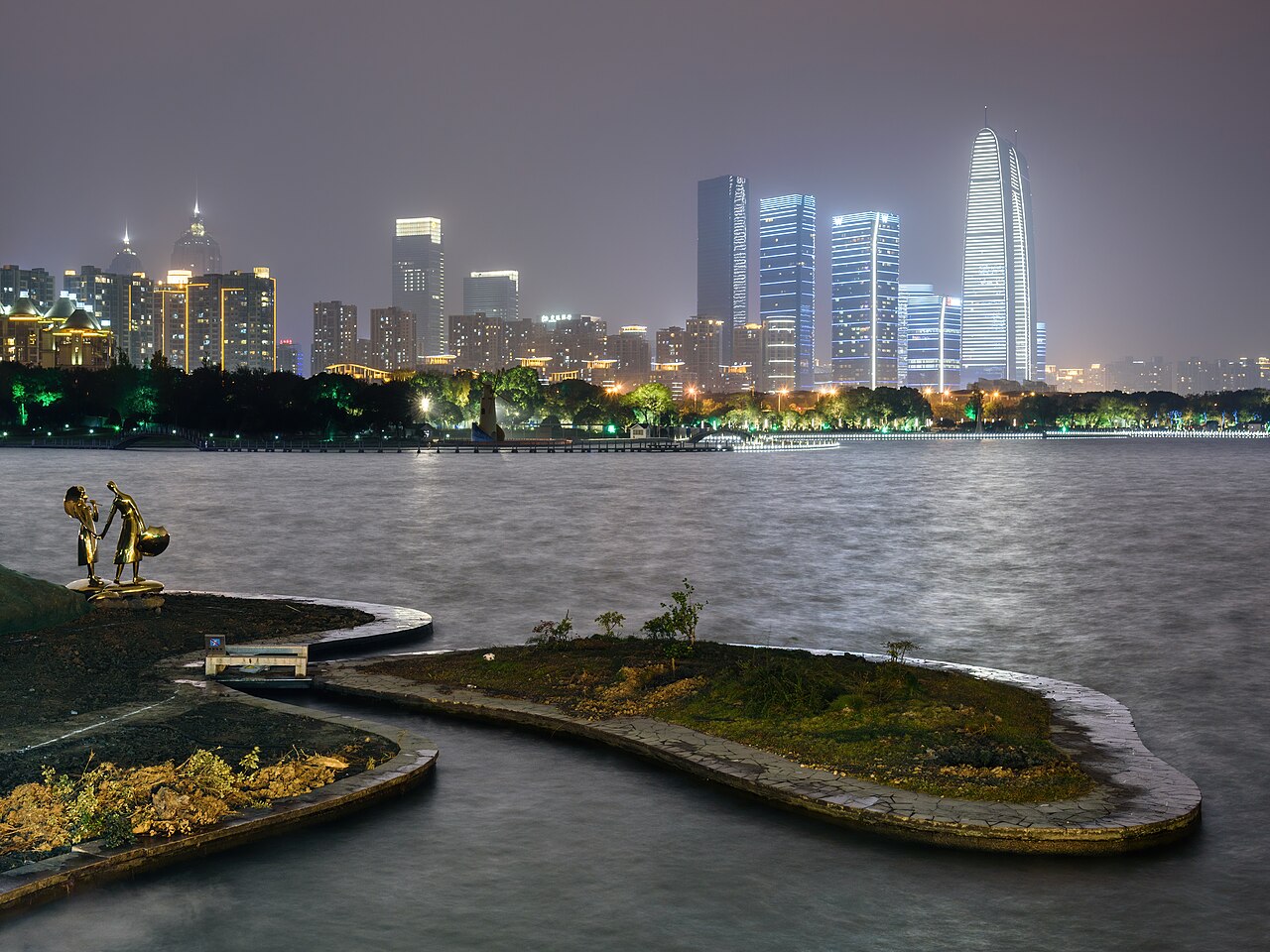
Modern Suzhou is in the Industrial Park east of the old city, around this large lake with a park and a path on every shore. The Gate of the Orient, a 301.8-metre arch-shaped tower completed in 2015, dominates the west shore and is best seen lit up at night. Ligongdi, a 1.4 km causeway built in 1890 and 1891, is now lined with restaurants. The Suzhou Eye Ferris wheel, which opened in March 2025, rises on the east side. The shore is free. Take Line 1 to Dongfangzhimen. See Jinji Lake.
Eating in Suzhou
Suzhou food is seasonal and on the sweet side, which takes some getting used to. The showpiece dishes are squirrel-shaped mandarin fish, deep-fried and served in a sweet-and-sour sauce, and sizzling eel paste. Look out too for Suzhou-style mooncakes with flaky pastry, braised tofu, and sweet lard rice cakes from the old bakeries. A bowl of Suzhou noodles in clear broth, with toppings chosen separately, makes a good early breakfast before the gardens open.
Guanqian Street is the busy central shopping street, and the lane of Taijian Nong to its south is known for restaurants. Pingjiang Road and Shantang Street are better for snacking as you walk. In autumn, hairy crabs from Yangcheng Lake are the seasonal treat. They are expensive, and plenty of crabs sold as "Yangcheng Lake" come from elsewhere, so buy from established restaurants.
How to arrange the route
Day 1, the old city. The Humble Administrator's Garden at 07:30, then Suzhou Museum next door if you've booked it (closed Mondays). Lunch, then the length of Pingjiang Road in the afternoon. Evening at Guanqian Street, or on a canal boat.
Day 2, north-west Suzhou. Tiger Hill in the morning. Walk or take a short ride to Shantang Street for lunch: the street follows the canal that Bai Juyi had dug from Tiger Hill to the city gate in 825. Hanshan Temple and Maple Bridge in the afternoon. With energy left, take the metro to Jinji Lake for the night view.
Day 3, a water town. Zhouzhuang, or Tongli if you'd rather have a quieter town closer to the city. Back in Suzhou for dinner, or stay the night in the water town.
Onward travel. Shanghai is about half an hour east by fast train. Hangzhou is 45 minutes to an hour from Suzhou South, or longer via Shanghai on other routes. Wuxi, on Lake Tai, is a short hop west. Nanjing is about an hour or more further along the same line, and Yangzhou and Changzhou are also within easy reach.
What to cut if short on time
Drop in this order:
- Jinji Lake, unless you want modern Suzhou at night.
- The water town. Pingjiang Road and Shantang Street give you canals without the day trip.
- Hanshan Temple, if you're not drawn by the poem.
- Tiger Hill, last. Keep the Humble Administrator's Garden and Pingjiang Road at all costs.
Things to confirm before you go
- Humble Administrator's Garden: real-name booking 1 to 7 days ahead, the price for your month, and last entry (17:00 from March to October, 16:30 in winter).
- Suzhou Museum: free but bookable up to 7 days ahead, closed Mondays except public holidays.
- Tiger Hill: peak or off-peak price, and last entry (17:30 from May to October, 17:00 from November to April).
- Zhouzhuang: the 80-yuan price in force since July 2026, and the bus times back to Suzhou.
- Which station your train uses: Suzhou, Suzhou North, Industrial Park and Suzhou South are far apart.
- Shoes: gardens and old towns are paved in uneven stone, slippery in rain.
Frequently asked questions
How many days do you need in Suzhou?
Two days covers the main gardens, Pingjiang Road, Tiger Hill and Hanshan Temple. Add a third for a water town.
Do you need to book the Humble Administrator's Garden?
Yes. Tickets are real-name and for a time slot, sold 1 to 7 days ahead, and holiday dates sell out.
Which Suzhou gardens are best?
The Humble Administrator's Garden first. Then add one of the Lingering Garden, the Master of the Nets Garden or the Lion Grove for a contrast.
Zhouzhuang or Tongli?
Zhouzhuang is the more famous, with the Twin Bridges, but it is busy. Tongli is quieter and closer to Suzhou. Pick one.
Is Suzhou a good day trip from Shanghai?
Yes. Trains take about 30 minutes, so a day for the Humble Administrator's Garden and Pingjiang Road is easy. A night lets you see Tiger Hill and the canals too.
Sources
The historical and geographic facts were checked against these Chinese Wikipedia entries, retrieved 11 August 2026.
- Suzhou (city) https://zh.wikipedia.org/wiki/苏州市
- Humble Administrator's Garden https://zh.wikipedia.org/wiki/拙政园
- Tiger Hill https://zh.wikipedia.org/wiki/虎丘
- Hanshan Temple https://zh.wikipedia.org/wiki/寒山寺
- Pingjiang Road (Suzhou street) https://zh.wikipedia.org/wiki/平江路_(苏州街道)
- Zhouzhuang Town (Kunshan) https://zh.wikipedia.org/wiki/周庄镇_(昆山市)
- Jinji Lake https://zh.wikipedia.org/wiki/金鸡湖
Ticket prices, hours, booking rules and transport were rechecked on 10 October 2026 against the Zhouzhuang scenic area's official site (zhouzhuang.net), the Suzhou municipal government and Suzhou Culture, Radio, TV and Tourism Bureau notices, the Suzhou Industrial Park administration, and 2026 listings compiled by Suzhou Bendibao for the Humble Administrator's Garden, Tiger Hill, Hanshan Temple and Suzhou Museum. The official notice on the day takes priority.
All photos are from Wikimedia Commons, used under CC licenses; re-use requires attribution.
- suzhou-zhuozheng.jpg from File Humble_Administrator's_Garden_Suzhou_November_2017_008.jpg, by King of Hearts, taken November 2017, CC BY-SA 4.0
- suzhou-huqiu.jpg from File Yunyansi_Pagoda_2.jpg, by Chinatravelsavvy, CC BY-SA 3.0
- suzhou-hanshan.jpg from File Feng_Qiao_of_Suzhou.jpg, by Gisling, taken October 2005, GFDL, CC BY-SA 3.0
- suzhou-pingjiang.jpg from File Suzhou_Pingjiang_Road.jpg, by Zhangzhugang, taken February 7, 2011, CC BY-SA 3.0 and GFDL
- suzhou-zhouzhuang.jpg from File Zhouzhuang1.jpg, by Gisling, taken in 2006, GFDL, CC BY-SA 3.0 and CC BY 2.5
- suzhou-jinjihu.jpg from File Jinji_Lake_Suzhou_November_2017_002.jpg, by King of Hearts, taken November 2017, CC BY-SA 4.0