Shaoxing Travel Guide: Lu Xun's Street, Poets' Gardens and the Canal Lakes
Shaoxing is an old canal city in northern Zhejiang, 67 km from Hangzhou, and its sights split neatly into three days: Lu Xun's Native Place and Shen Garden in the town centre, East Lake and the Mausoleum of Yu the Great to the east, and Keyan and the Orchid Pavilion to the west. Getting there is simple. Since June 30, 2025, metro Line 1 has linked Shaoxing North high-speed station with Lu Xun Native Place in about 30 minutes, and from Hangzhou you can ride the metro all the way.
A city of wine, writers and water
Shaoxing, abbreviated Yue and nicknamed Yuecheng, was the capital of the state of Yue in the Spring and Autumn period, later known as Kuaiji and Yuezhou. Its present name comes from the Shaoxing reign of the Southern Song, meaning "continuing the mandate and restoring the dynasty". The municipality covers about 8,279 square kilometres and had 5.34 million people in 2021. It is a national historic city, the home of Shaoxing yellow wine, and lies on the south shore of Hangzhou Bay, 108 km from Ningbo.
Most of what visitors see is about people who lived or passed through here: the writer Lu Xun, the poet Lu You, the calligrapher Wang Xizhi and the legendary flood-tamer Yu. Several sites are rebuilt, and some stories are disputed, so it helps to know what is old and what is not before you go.
When to come to Shaoxing
Shaoxing has a humid subtropical climate, with an annual mean of about 16 to 17°C and roughly 1,400 to 1,456 mm of rain. January averages around 4 to 5°C and July 28 to 29°C. Spring and autumn are best for gardens and canal walks, and less likely to lose an out-of-town day to the plum rains of early summer or a typhoon. In summer, keep East Lake and the Orchid Pavilion as movable days.
Getting in and around
- From Hangzhou by metro: Hangzhou Metro Line 5 to Guniangqiao, then change to Shaoxing Metro Line 1, which runs to Lu Xun Native Place station. Slow but cheap and simple.
- By high-speed rail: trains from Hangzhou East to Shaoxing North take about 20 minutes. Since June 30, 2025, a branch of Line 1 serves Shaoxing North directly, and it is about 30 minutes from there to Lu Xun Native Place.
- In town: Lu Xun Native Place station, exit B, comes out at the scenic street, and Shen Garden is a short walk east.
- To the Orchid Pavilion: tourist bus line 0003 runs from the Lu Xun Native Place bus stop to the Lanting scenic area stop.
- To East Lake, Yu Mausoleum and Keyan: city buses or taxis; the two eastern sights pair well, as do the two western ones.
Stay in the old town near Lu Xun's street to walk to restaurants and the canals in the evening.
Places worth visiting
Lu Xun Native Place
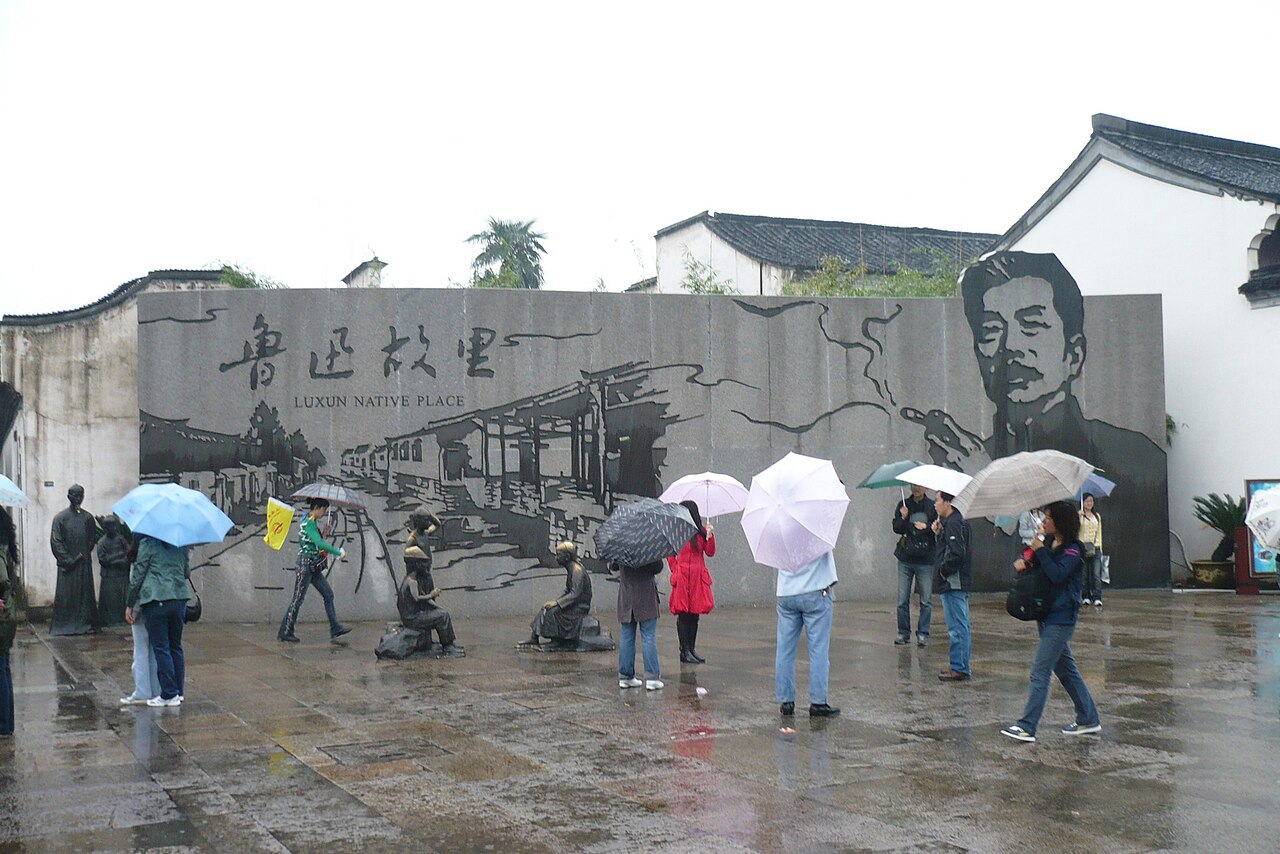
The Native Place runs along Luxun Middle Road and takes in the Zhou ancestral house (the "old taimen"), Lu Xun's former home (the "new taimen", with Baicao Garden behind it), the Sanwei Study, the Shaoxing Lu Xun Memorial Hall and, just to the west, Xianheng Hotel. Lu Xun, born Zhou Shuren, was born here in 1881 and left in 1898. His former home, at number 229, faces south and covers about 580 square metres in six courtyards; the ancestral house to the east is about 2,400. The Sanwei Study, where he went to school, is a single row of rooms of about 35 square metres across the river from the ancestral house.
The group was listed in 1988, in the third batch of nationally protected sites, and the street is a national 5A scenic area. Visit the houses first, then Baicao Garden, then cross to the study. Xianheng is a restaurant that takes its name from the tavern in Lu Xun's story Kong Yiji, not a museum; order fennel beans and yellow wine if you sit down. Check hours on the official notice. The Lu Xun Native Place page walks the courtyards in order.
Shen Garden
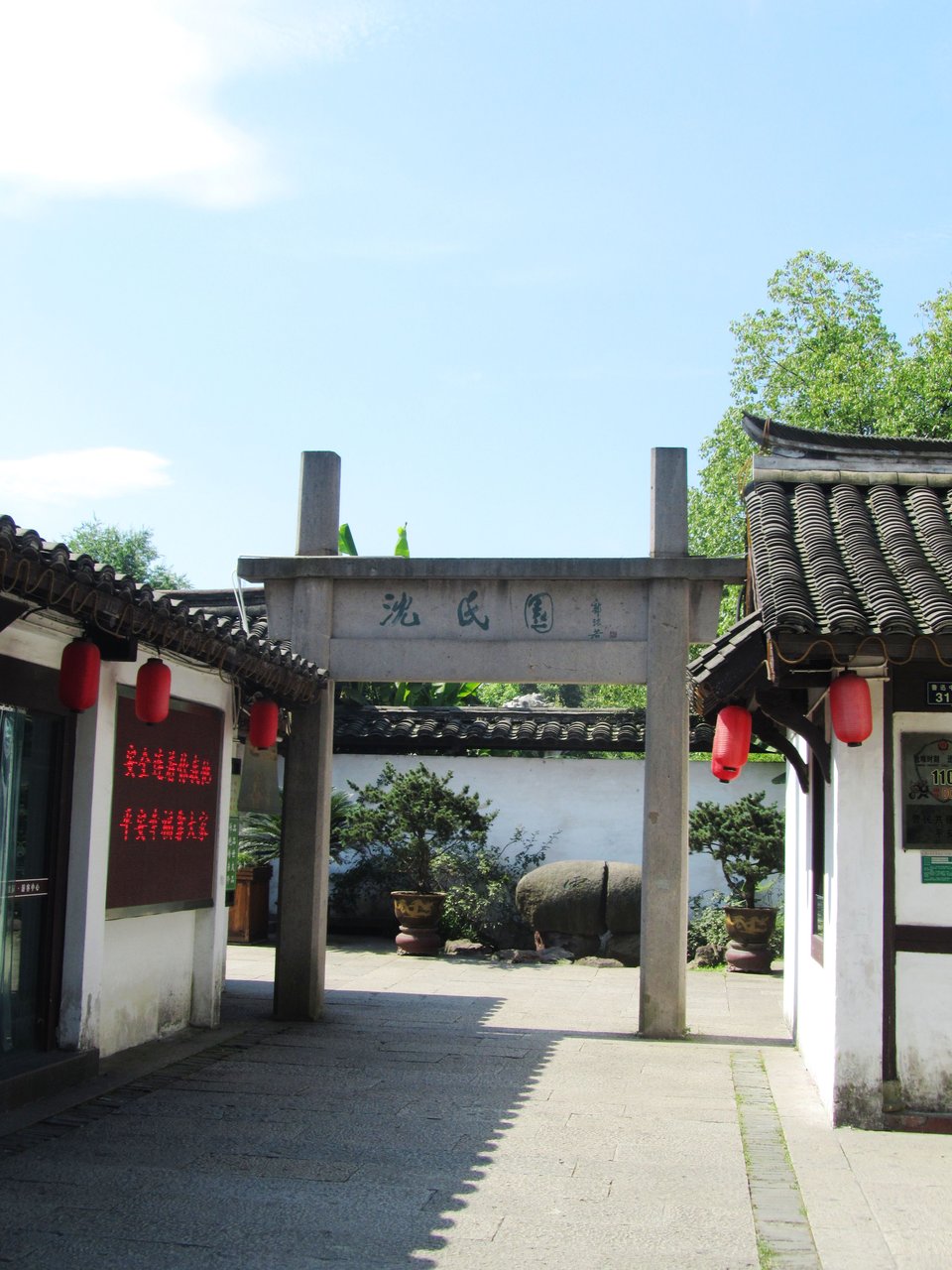
Shen Garden, in Yanghe Lane in the southeast of the old town, is a small Jiangnan garden known for the poet Lu You and his first wife Tang Wan. The Song dynasty Shen garden is where Lu You is said to have written the lyric Chaitou Feng after meeting her again by chance. A later owner, Shen Youyuan, bought a garden here before 1738 and linked it to the story; researchers disagree on whether the Song garden was on this spot or outside the city to the southeast. What you see is a Qing-to-modern site, listed as a Zhejiang protected site in 1963, rebuilt in 1984 from an old painting of the garden and restored again in 1994. The gourd-shaped pool, a well and an earth mound are considered Song survivals.
The gate tablet is in Guo Moruo's calligraphy, and Xia Chengtao wrote out Chaitou Feng on the wall. Come for the poem and a short stroll, not a grand estate; it fits easily on the same day as Lu Xun's street. More in Shen Garden.
Orchid Pavilion
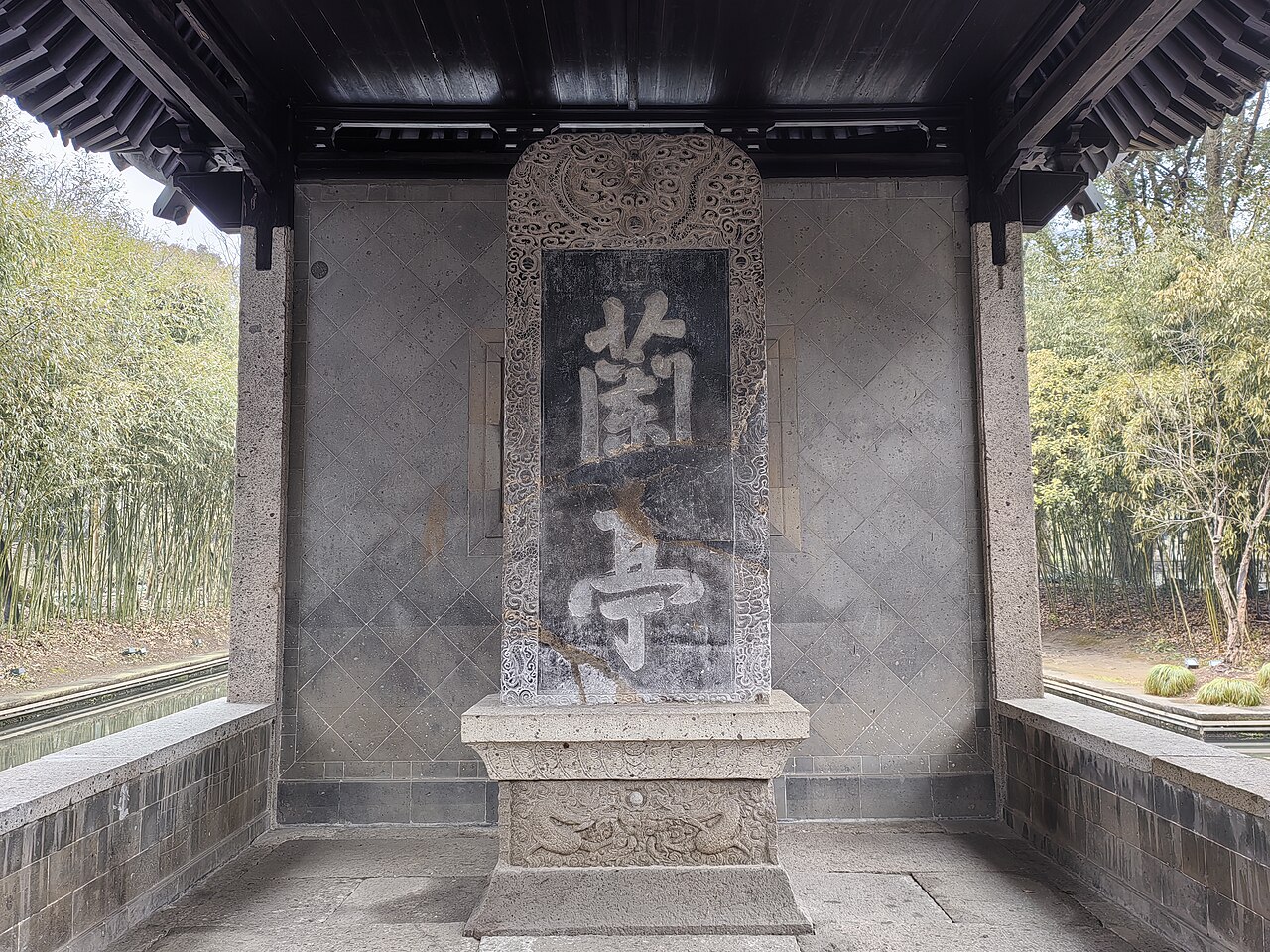
The Orchid Pavilion stands at the foot of Lanzhu Hill, about 13 km southwest of town. In 353, on the third day of the third lunar month, Wang Xizhi, then administrator of Kuaiji, gathered more than forty men here for a spring purification rite, and his Preface to the Orchid Pavilion Collection became the most famous work in Chinese calligraphy. By tradition King Goujian of Yue planted orchids here and a Han post station gave the place its name. The present site was rebuilt in 1548 by the prefect Shen Qi and altered later, and was listed nationally in 2013.
The photograph shows the Kangxi emperor's "Lanting" stele, broken into four pieces during the Cultural Revolution and pieced together with the last stroke of lan and the first of ting missing. Goose Pond, the Winding Stream Pavilion where the poets floated wine cups, the Right Army Shrine and later copies of the preface are in the same park. The buildings are Ming and Qing restorations. Allow half a day. See Orchid Pavilion for the walking order.
East Lake
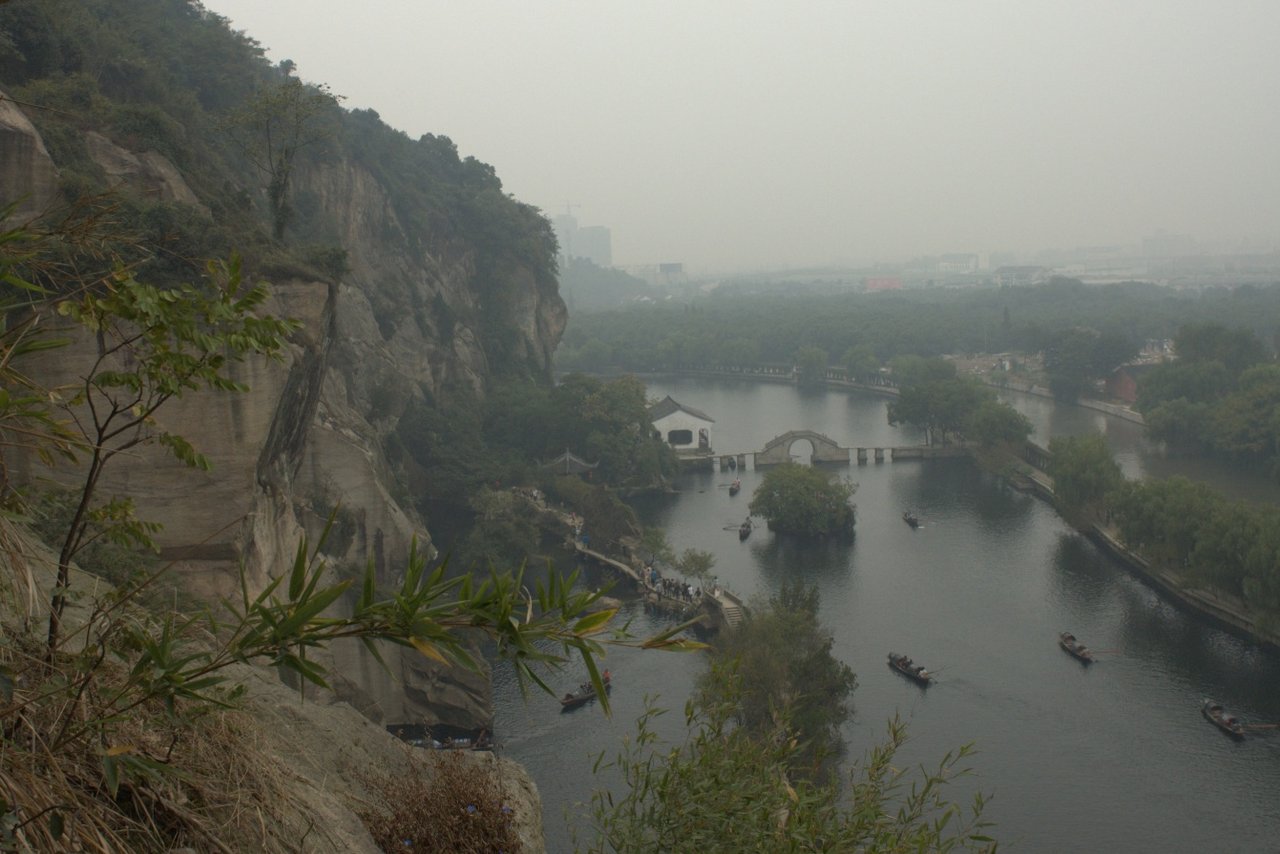
East Lake, at Gaobu east of the old town, is a flooded quarry. From the Han dynasty stonecutters took stone from the hill here, once called Ruoshan, and in the Sui Yang Su quarried deeper to build the city wall. By the late Qing half the hill was gone, leaving cliffs that drop straight into the water. Tao Junxuan then built a long dike, inspired by The Peach Blossom Spring, separating river from lake, and named it East Lake. It is often grouped with Hangzhou's West Lake and Jiaxing's South Lake as Zhejiang's three famous lakes, and is a national 4A site.
The boat is the reason to come: small black-awning boats go into Peach Cave, Horn Cave and Tao's Cave under the cliffs. Pavilions and bridges line the dike, and the Tao Society on the west side commemorates Tao Chengzhang. The caves are damp, and tickets follow official notices. More in East Lake.
Keyan
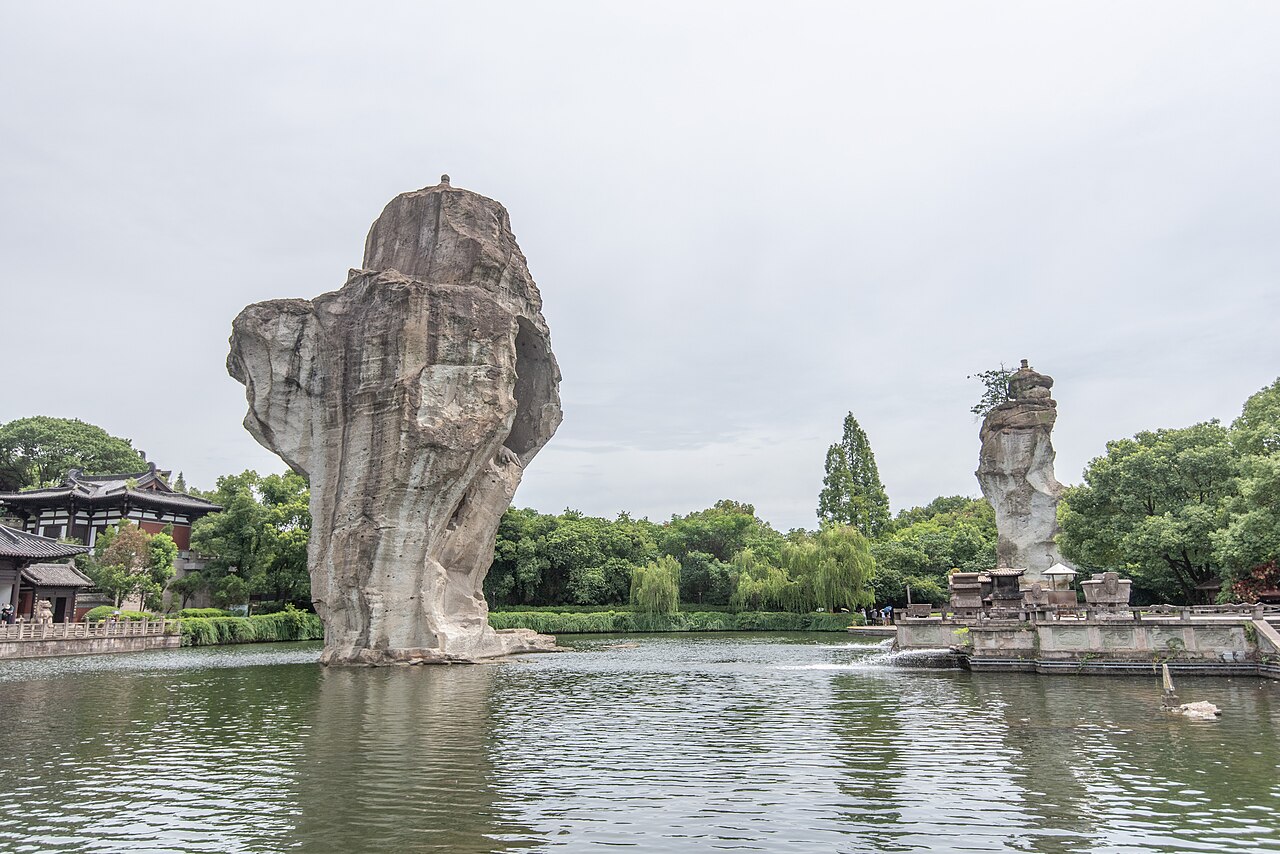
Keyan Scenic Area, in Keqiao District about 8 km west of town, covers 6.87 square kilometres in three parts, Keyan, Jianhu Lake and Luzhen, and became a national 4A site in 2000. Its best-known sights are the Heaven-Work Buddha, carved into a cliff, and the Cloud Bone, a tall, thin pillar of rock left behind by quarrying. Both are protected as the "Keyan images and cliff inscriptions". Jianhu is the lake whose water was traditionally used for Shaoxing wine. Sources do not give a firm date for the Buddha. Luzhen, a recreated town based on Lu Xun's stories, is a later add-on. Keyan pairs with the Orchid Pavilion on a western day; see Keyan.
Yu Mausoleum
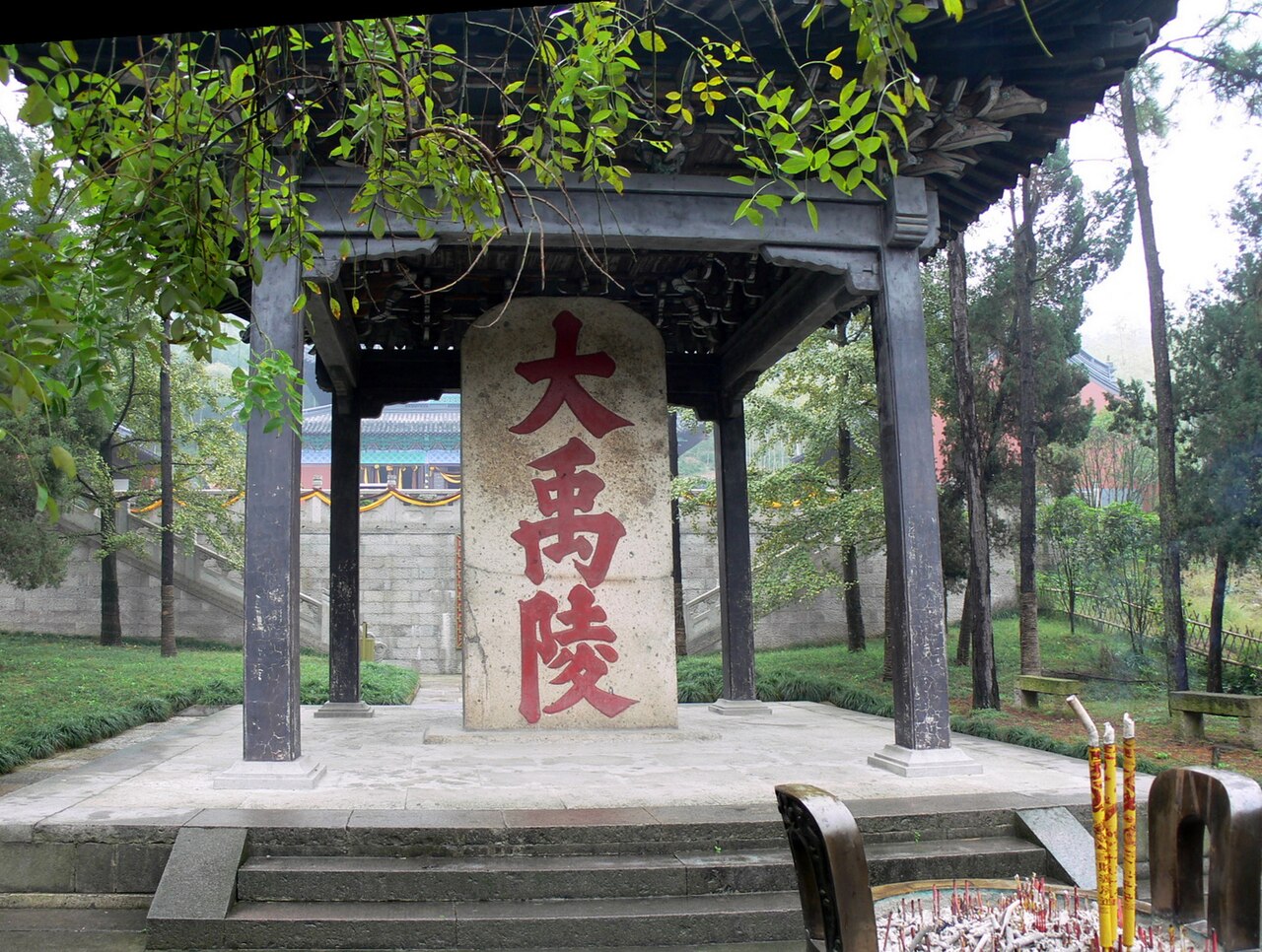
The Mausoleum of Yu the Great, in Yuling village about 8 km southeast of town on the west slope of Kuaiji Mountain, is a memorial tomb for Yu, the legendary tamer of floods and founder of the Xia. Tradition says his son Qi built a shrine here, and the palace-style temple to the northeast dates its founding to the early Liang dynasty of the Southern Dynasties. It was listed nationally in 1996.
During the Cultural Revolution the statue and much of the temple were destroyed; Zhou Jianren, Lu Xun's brother, then on the provincial revolutionary committee, is credited with preventing the total demolition. Repairs ran from 1976 to 1981, and the offering hall was rebuilt in 2007 and 2008. The Goulou stele, with 77 "tadpole" characters, is locally attributed to Yu, though scholars doubt it. Treat the halls as modern rebuilds on an ancient site. See Yu Mausoleum.
Eating in Shaoxing
Yellow wine, also called "old wine", is the city's drink and its cooking seasoning. Fennel beans, stinky tofu and meigan cai (dried mustard greens), especially braised with pork, are the classic dishes to go with it. Shaoxing mallard and Wangtan waxberries are other local names. Xianheng on Lu Xun's street sells the literary version; neighbourhood restaurants sell the everyday one. Better bottles of wine carry a vintage year on the label.
How to arrange the route
Day 1, the old town: Lu Xun's Native Place in the morning, fennel beans and wine at lunch, Shen Garden in the afternoon, a canal walk at dusk.
Day 2, east: East Lake by boat in the morning, the Yu Mausoleum in the afternoon.
Day 3, west: Keyan in the morning, the Orchid Pavilion in the afternoon.
With two days, keep day 1 and do East Lake and the Orchid Pavilion on day 2, dropping Keyan and Yu.
Hangzhou is about 20 minutes away by high-speed train. Ningbo is east, Taizhou is south toward the Tiantai mountains, and Suzhou is the garden city across the bay.
What to cut if short on time
With one day, stay in the old town: Lu Xun's Native Place, Shen Garden and a canal walk. Keyan is the first out-of-town sight to drop, then the Yu Mausoleum; the Orchid Pavilion and East Lake are the two that are hardest to replace.
Things to confirm before you go
- Tickets and hours for all six sites, from official notices.
- East Lake boat operations in heavy rain or typhoons.
- Metro times if you are going back to Hangzhou in the evening.
Frequently asked questions
How do I get from Hangzhou to Shaoxing?
By high-speed train from Hangzhou East to Shaoxing North in about 20 minutes, then metro Line 1 to Lu Xun Native Place in about 30 minutes; or by Hangzhou Metro Line 5 to Guniangqiao and Shaoxing Metro Line 1.
How many days do I need in Shaoxing?
Three days covers the town, the eastern pair and the western pair. Two days covers Lu Xun, Shen Garden and one out-of-town sight.
Lu Xun's street or the Orchid Pavilion, if I can only pick one?
Lu Xun's street for the town, the food and the canals; the Orchid Pavilion if calligraphy is why you came.
Is Shen Garden the real Song garden?
That is disputed. Treat it as a garden that keeps the poem alive, not as proven Song ground.
Sources
The facts in this article were checked against the following sources, retrieved September 4, 2026, and rechecked on October 20, 2026.
- Shaoxing (city) https://zh.wikipedia.org/wiki/绍兴市
- Lu Xun's Native Place https://zh.wikipedia.org/wiki/鲁迅故里
- Shen Garden https://zh.wikipedia.org/wiki/沈园
- Orchid Pavilion https://zh.wikipedia.org/wiki/兰亭
- East Lake (Shaoxing) https://zh.wikipedia.org/wiki/绍兴东湖
- Keyan Scenic Area https://zh.wikipedia.org/wiki/柯岩风景区
- Mausoleum of Yu the Great https://zh.wikipedia.org/wiki/大禹陵
- Shaoxing Metro Line 1 branch to Shaoxing North opens (Xinhua Zhejiang, July 2025) http://www.zj.xinhuanet.com/20250702/b8c8c83202bc4bf193e1be7ed0d0f195/c.html
- Metro to Lu Xun Native Place (Shaoxing Bendibao) http://sx.bendibao.com/tour/2023411/19495.shtm
- Getting to Shen Garden and the Orchid Pavilion (Shaoxing Bendibao) http://sx.bendibao.com/tour/202323/18365.shtm
The East Lake and Keyan entries are short; the sites' make-up follows those pages and the scenic areas' public information. Shen Garden's location relative to the Song garden is given as the page gives it, as a disagreement.
All photos are from Wikimedia Commons, used under CC licenses; re-use requires attribution.
- shaoxing-luxun.jpg from File Luxun_native_place.JPG, by Gisling, CC BY 3.0
- shaoxing-shenyuan.jpg from File Shen_Garden_in_Shaoxing_2012-07.JPG, by 猫猫的日记本, CC BY-SA 3.0
- shaoxing-lanting.jpg from File 20240130_Lanting.jpg, by Yumeto, CC BY-SA 4.0
- shaoxing-donghu.jpg from File Shaoxingdonghu.jpg, by Zhang Qi, CC BY-SA 3.0
- shaoxing-keyan.jpg from File Keyan_Scenic_Area,_2021-07-17_06.jpg, by Siyuwj, CC BY-SA 4.0
- shaoxing-dayu.jpg from File Yu_the_Great_mausoleum_stele_in_Shaoxing, Zhejiang, China.jpg, by Gisling, CC BY-SA 3.0